Journal · Brand
Your best photos are the ones getting called AI
Real photos from small shops now get accused of being AI, and polish makes it worse. Post the making-of instead: 36 percent of consumers say AI video lowers their trust in a brand.
A smokehouse in Speedway posted a photo of a brisket last month. Bark like tree bark, steam still lifting off the slice. Third comment down: is this AI?
It was not. It was a Sunday morning, a phone propped against a napkin dispenser, and about nine seconds of effort. The owner sent me a screenshot because she could not tell whether to be flattered or worried.
Be worried, a little. Then go film your smoker.
Something changed this year in how people look at pictures, and it has nothing to do with how good yours are. It has to do with how good the fakes got. Polish used to say this shop cares. Now it says nobody was standing there. Your proof stopped being the picture. Your proof is the footage of you taking it.
Apple worked this out two days ago and spent real money on it.
Apple filmed the proof
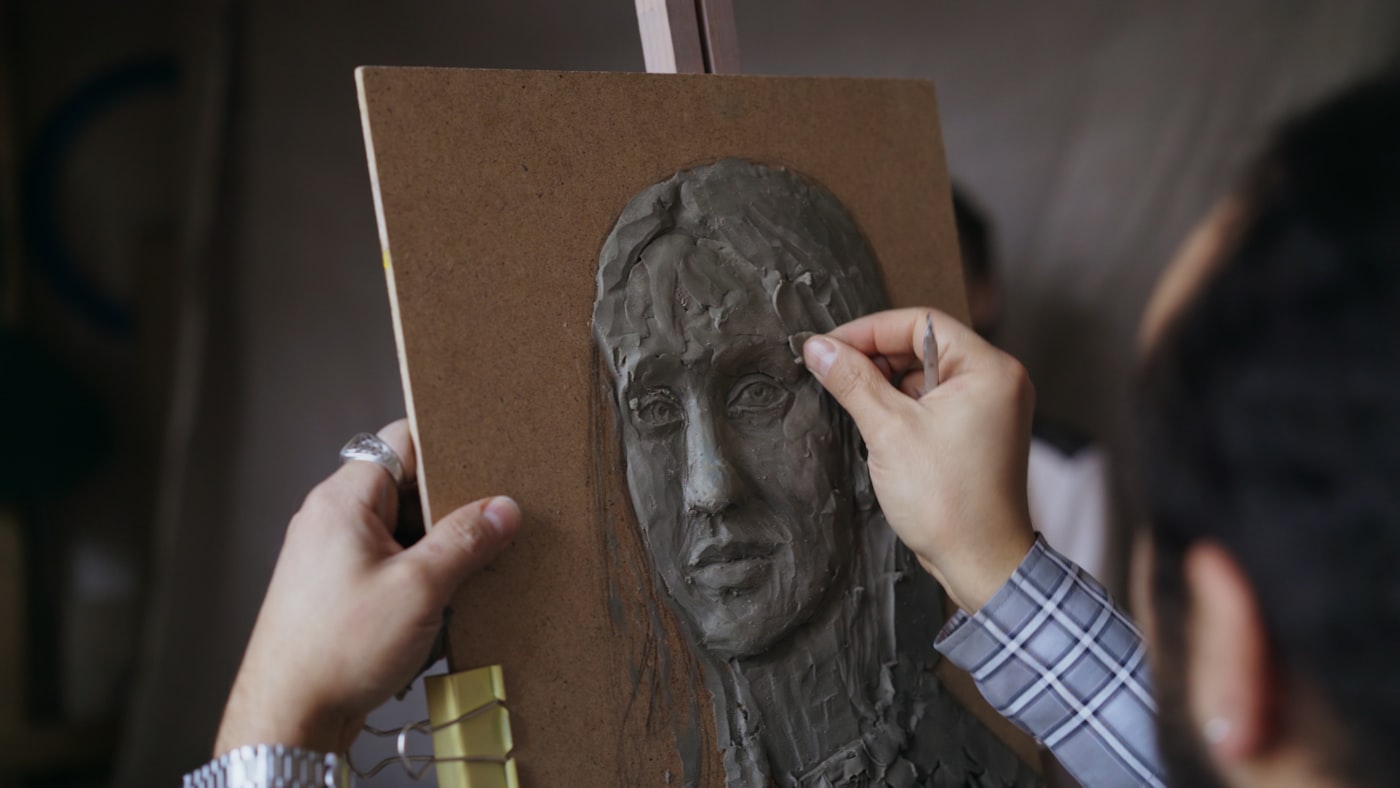
On August 25 Apple posted a behind-the-scenes reel to its @helloapple account. Not a product video. Footage of two animators, Justin Rasch and Scott DaRos, hunched over a table sculpting clay.
The ad they were building is called The Mighty Mac Mini with M6, made by TBWA\Media Arts Lab with animation studios Blinkink and Stoopid Buddy Stoodios, directed by Nicos Livesey. A Mac mini turns into a bodybuilder, then a race car, then a rocket. All clay, shot frame by frame, the way Wallace and Gromit was made.
Watch it cold and you would guess AI. That is the whole reason the second video exists. It shows the hand-drawn storyboards, the sculpted M6 chip, Rasch laying finishing paint on with a brush. DaRos says it flat: "We have to sculpt and craft everything by hand. There's no shortcuts."
Apple has more visual credibility than any brand alive, and it still filmed the proof.
Sit with what that implies for a shop with 400 followers. The company that put a camera in every pocket assumes it will be doubted. You should assume it too.
Why does everyone think my photos are AI?
Because they have been trained to, and because they are often right.
Animoto published its 2026 State of Video Report in January. Of the U.S. consumers surveyed, 83 percent said they can identify an AI-generated video on sight. 36 percent said seeing one lowers their trust in the brand that posted it. The giveaways they named were robotic gestures at 67 percent, unnatural voices at 55 percent, and a flat emotional tone at 51 percent.
Gartner then put a price on that suspicion. In a March 2026 survey of U.S. consumers, 50 percent said they would rather give their business to brands that keep generative AI out of the things customers see. By June 2026 Gartner reported that 49 percent believe AI has made content quality worse across the board.
Half your customers hold a mild grudge against the tool. One in three will dock you for using it. Neither group is checking. Both are guessing.
They guess badly, too. Back in 2024, Meta launched a "Made with AI" label and started attaching it to real photographs. Pete Souza, who shot the Obama White House for eight years, got tagged. He traced it to a crop-and-flatten step in Adobe. Meta softened the wording to "AI info" that July and left the rest unexplained. Destiny covered what that label does when it lands on your ad, and the short version is that it costs you.
Two years of that taught people a habit. AI became something you can accuse a picture of for free, with no evidence and no consequence.
Google now offers a check, at least. Its About This Image panel will tell a customer where a photo came from and when it first appeared, which I walked through in asking Google whether your photo is real. Almost nobody uses it. Typing the comment is faster.
What actually reads as fake
I went back through a few dozen Indiana shop feeds this week looking at which posts drew the accusation. The pattern holds, and none of it is about quality.
Too clean. No crumbs on the tray, no fingerprints on the case, no scuff on the counter. A real bakery case at 7am has flour smeared across the glass at hand height.
Too even. Every item spaced the same distance apart, a soft rim of light on everything, no shadow falling anywhere awkward. That was a compliment in 2019. Now it looks generated.
Nobody home. An empty room, an empty chair, a plate on a table with no arm reaching for it. Hands in frame are the cheapest authenticity signal you have, and most shops crop them out.
Nowhere in particular. A white sweep background tells a customer nothing about whether you exist. The window behind the counter, with the parking lot and the gray Indiana sky in it, tells them everything.
The uncanny sheen. Skin, fur, and food are where the tells live. Over-sharpen a brisket and it stops looking like meat and starts looking like a render of meat.
A jeweler in Carmel showed me a ring photo she had paid a retoucher for. It was beautiful and it looked synthetic. The version she shot herself, on the bench, with a loupe and a coffee mug in the corner of the frame, got triple the saves. I wrote about that pattern last spring in the photo your customers keep saving, and it has only gotten more true since.
What should I post instead?
Five things, none of which cost money.
Film the making before you shoot the result. Fifteen seconds of hands. Kneading, wrapping, torching, sanding, foiling. Post it as a reel and pin it. This is the Apple move and it works at any size.
Put a person in the frame. An arm, a shoulder, a face. It does not have to be your face.
Keep one wide shot with the room in it. The wall, the window, the mess in the background. Location is proof.
Say the date out loud. "Tuesday morning batch." "Cut this at 4am." A timestamp in the caption does more for belief than any filter.
Keep the originals. If somebody presses you, the untouched file with its camera data settles it in one reply. Your camera roll is the receipt.
If your photos are already the phone-and-window-light kind, you are ahead of this. I laid out that setup in how to photograph your shop without a photographer. We put those photos on every site we build, which is part of why the work in our showcase looks like Indiana instead of a stock library.
The odd part of this year is that the shops with the smallest budgets have the easiest time of it. A brisket shot on a phone at 6am, flour on the glass, somebody's thumb in the corner. All of that costs nothing now and buys more than a studio day.
Apple needed a film crew to prove a human was in the room. You only need to turn the camera around.
Sources
| # | Source | What it backed up |
|---|---|---|
| 1 | Apple shares behind-the-scenes video for its fun new Mac mini ad | The August 25, 2026 BTS reel on @helloapple, and animators Justin Rasch and Scott DaRos. |
| 2 | Ad of the Day: Apple turns the new Mac Mini into a claymation superhero | The ad title, TBWA\Media Arts Lab, Blinkink, Stoopid Buddy Stoodios, director Nicos Livesey, and the DaRos quote. |
| 3 | 83% of Consumers Can Spot AI Videos and 36% Say It Lowers Brand Trust | Animoto's January 2026 State of Video Report figures, including the 67, 55 and 51 percent giveaways. |
| 4 | Gartner Marketing Survey Finds 50% of Consumers Prefer Brands That Avoid Using GenAI | The March 2026 finding that half of U.S. consumers prefer brands avoiding GenAI in consumer-facing content. |
| 5 | Gartner Survey Finds 49% of U.S. Consumers Say GenAI Has Made Content Quality Worse | The June 2026 content-quality figure. |
| 6 | Meta is tagging real photos as Made with AI | Pete Souza's mislabeled photo in 2024 and the Adobe flatten-and-crop cause. |
| 7 | Meta changes its label from Made with AI to AI info | The July 2024 relabelling. |
| 8 | Building Trust in the Age of AI, Getty Images | Historical 2024 baseline that 90 percent of consumers want AI disclosure and 76 percent cannot tell whether an image is real. |