Journal · Brand
The font in your logo might not be licensed for your sign
A standard font license covers your designer's computer and her print files, not your website, your awning, or your t-shirts. Most shops find out the week they order signage.
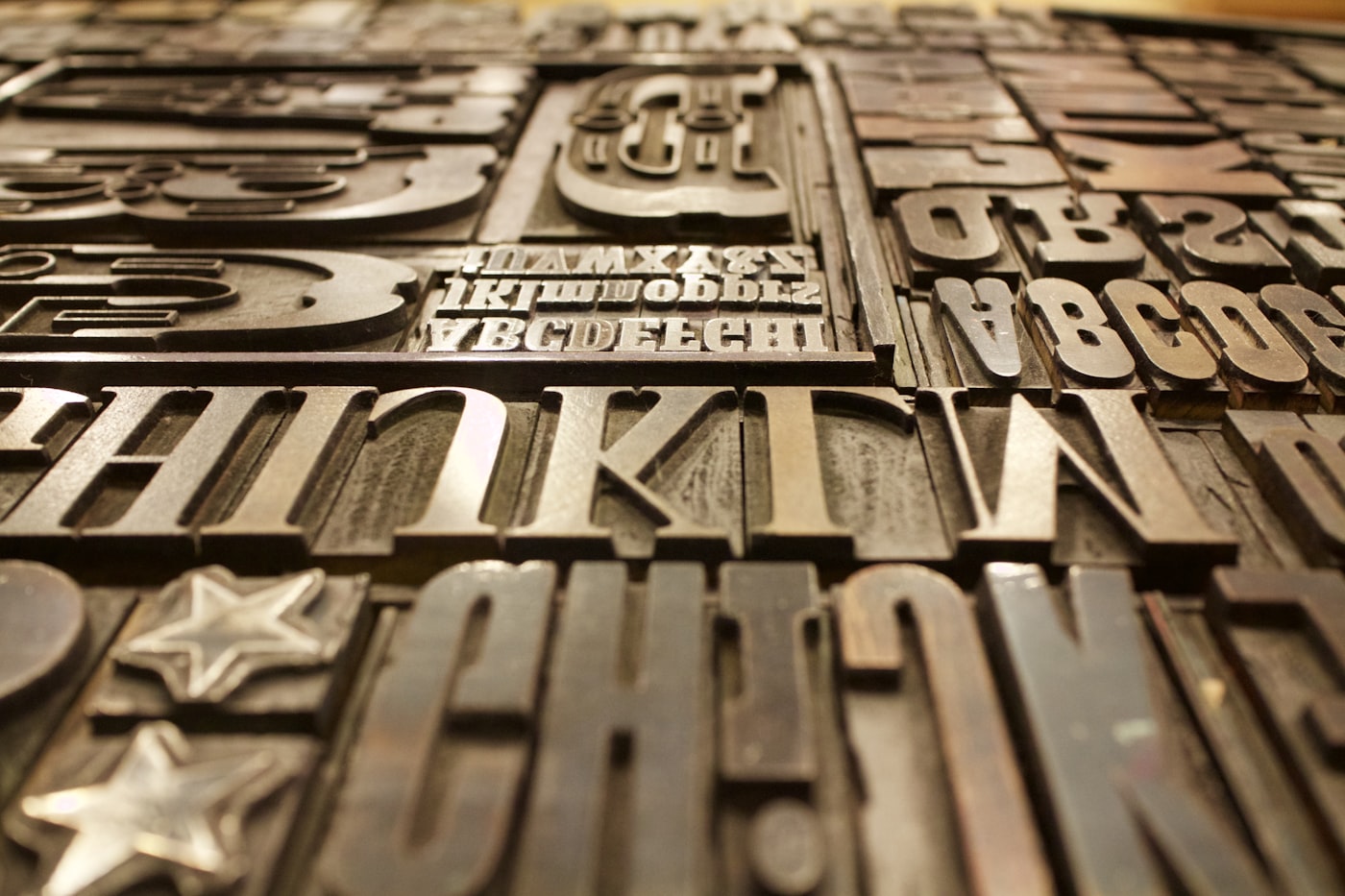
A butcher shop in Irvington ordered a new awning in May. The sign maker had one question before he would start cutting vinyl: can you email me the font?
The owner forwarded that to the designer who drew his logo two years ago. She wrote back that she could not send it. Not that she would rather not. That she could not.
A font license is a list of places you are allowed to put the letters. The standard one a designer buys covers her computer and the files she prints from it. It does not cover your website. It frequently does not cover a sign, a shirt, or emailing the file to a third party. Most shop owners meet this rule for the first time in the week they order signage, which is a bad week to meet it.
What you actually bought when you bought a font
Fonts are software, and they get licensed like software. The type industry sells the same typeface several times over, sliced by where the letters end up.
A desktop license covers installing the font on somewhere between one and five computers and making static things with it. Posters, PDFs, a menu you send to the printer. That is the license almost everyone has.
A web license is separate, and it is the one that lets the font live in your site's code. Many of them meter you by pageviews. Fontspring's smallest web tier runs half a million pageviews and resets every month. Monotype counts theirs across a year. A dry cleaner doing 8,000 pageviews a month will never come close. A shop that lands on the local news once might.
App licenses and server licenses are sold separately again. Digital menu boards and print-on-demand setups usually need that third kind, which nobody tells you until the invoice.
Why can't I just email my sign maker the font?
If your designer works in Creative Cloud, her fonts come from Adobe Fonts, and they activate through her subscription rather than sitting in a folder she owns. Adobe's own documentation is direct about it: your printer or sign maker needs their own license, either a Creative Cloud subscription or a purchased desktop license. She has nothing to send you.
The second half of that is worse. When a Creative Cloud subscription lapses, the fonts deactivate. Anything already flattened keeps working, because a PDF or a JPG has the letters baked in. The layered logo file stops opening correctly. If you and your designer ever part ways, that layered file is exactly the one you needed.
What happens if you get it wrong?
Monotype runs a service called Brand and License Protection, and a tool called Font Detective that scans websites for unlicensed fonts. That is not a rumor passed around design forums. It is a product they sell to find people like your web guy from 2019.
Desktop licenses also tend to exclude logo and trademark use outright. So you can commission a wordmark, put it on your truck and 40,000 cups, and hear from a foundry's lawyers about it four years later. By then you are settling, and settling has never once cost less than buying the right license would have at the start.
If your logo came out of Canva, read this part twice
Canva's terms say you cannot use their Free or Pro stock content in a trademark. Fonts, simple shapes, and lines are carved out as exceptions.
So a wordmark you typed in a Canva font is fine. The moment you drop in Canva's little illustrated cleaver next to the shop name, you have built a mark you cannot register and cannot stop a competitor from using.
You can spend two years teaching a neighborhood to recognize a logo you were never allowed to own.
I see this one constantly, and it is always a shock, because Canva never stops you. It just quietly leaves you holding something unenforceable.
What can you use without any of this hanging over you?
Google Fonts. Nearly the whole library ships under the SIL Open Font License, and the OFL FAQ names the uses out loud: logos, posters, business cards, stationery, signage, t-shirts, personalised fabric, rubber stamps. Free for commercial work, no pageview ceiling, no attribution required, and it does not expire.
There are two real limits and neither will touch you. You cannot sell the font file by itself, and if you modify a font that carries a Reserved Font Name, you have to rename your version.
The library got good, too. Bricolage Grotesque and Recursive both came out of serious foundries, and Google Sans Flex landed there free a couple of weeks ago, which I wrote about at the time. Any of those will hold up on an awning.
The July change worth knowing about
NaN, the London foundry behind custom typefaces for Deezer, Wise, and Channel 4, launched a marketplace this summer called fonts.xyz. Independent foundries upload their work and keep 80% of every sale. There is an 80% student discount and a 1% solidarity tax on top.
The part that matters to a butcher shop is the license. One site-wide license covers every touchpoint, and the only thing that changes the price is the size of the company using it. No separate web tier. No pageview meter. No wondering whether an awning counts.
It is new, and the catalogue is a fraction of what Monotype carries. That is not a reason to redo your brand this month. But if you ever pay for type that is not on nine other Indianapolis websites, this is the license shape to look for.
The one thing to do this week
Email your designer three questions and keep the reply.
What font is my logo set in. What license do we hold. Does it cover signage, web, and merchandise.
If the answer is a Google Font, you are done, and you can stop reading about this forever. If the answer is a purchased font, ask for the license PDF and file it wherever your LLC paperwork lives. If nobody knows the answer, you now have a small problem on a Tuesday instead of a large one during your expansion.
The awning in Irvington went up in June. Different font, same butcher, and he is the only person on that block who could tell you it changed. Most brand problems end that way when you catch them early enough. Nobody notices, and you sleep fine.
Sources
| # | Source | What it backed up |
|---|---|---|
| 1 | Font licensing explained for designers and brands (Monotype) | Desktop, web, app, and server license splits, and the exclusion of logo/trademark use from desktop licenses. |
| 2 | Font licensing (Adobe Fonts help) | Printers and sign makers needing their own license; fonts activating through the subscription. |
| 3 | Removing fonts from the subscription library (Adobe) | What keeps working after a subscription lapses, and what stops opening. |
| 4 | Pageview FAQs (Fontspring) | The half-million pageview entry tier and the monthly reset. |
| 5 | SIL Open Font License FAQ | The named permitted uses, no attribution requirement, and the Reserved Font Name rule. |
| 6 | Canva's licensing explained | The trademark restriction on stock content and the carve-out for fonts, shapes, and lines. |
| 7 | The best new typefaces for July 2026 (Creative Boom) | The fonts.xyz launch, the 80% royalty, the student discount, and the solidarity tax. |
| 8 | Google gave away the font it uses on everything (Luminest) | Google Sans Flex going open source. |